Long-range radio link
SX1262 transceiver with a +30 dBm power amplifier reaches up to 15 km line-of-sight across the 410-525 MHz band. The firmware sweeps a preloaded frequency list, so a rescuer with a cheap SDR will hear the beacon.
Field rescue radio - 433 MHz - v6.0
Radio-location for mountain rescue and SAR teams, built from off-the-shelf parts. No GSM, no subscriptions, no network to transmit.
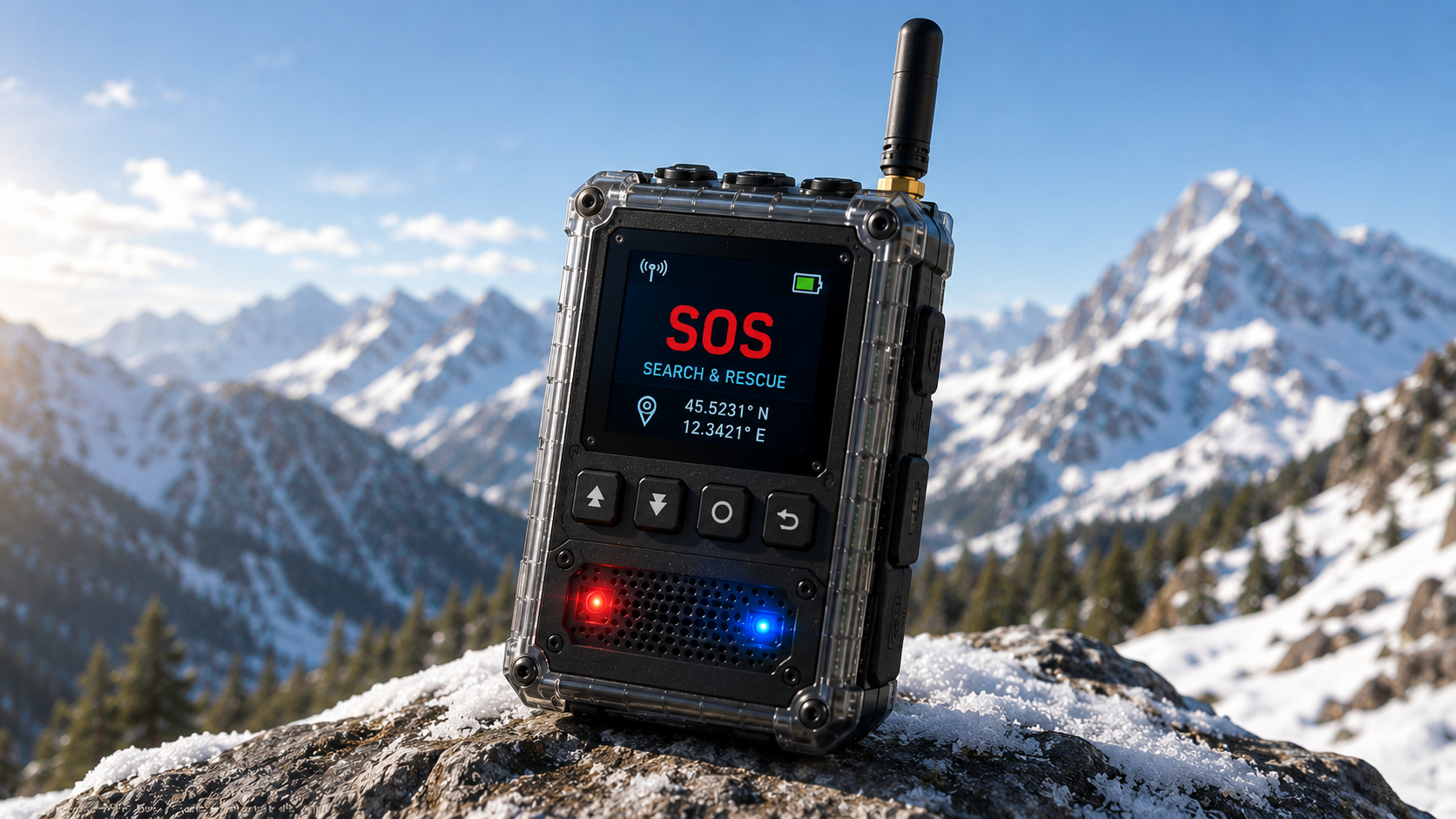
Radio, GPS and display in a pocket-sized case. One button starts the beacon.
When every other link drops, a direct radio signal still carries. The beacon encodes your name and position into Morse and sweeps a preloaded list of rescue frequencies, so any receiver tuned to the band can hear you.
Every component and every line of firmware exists to get your position to a rescuer, with nothing left to fail.
SX1262 transceiver with a +30 dBm power amplifier reaches up to 15 km line-of-sight across the 410-525 MHz band. The firmware sweeps a preloaded frequency list, so a rescuer with a cheap SDR will hear the beacon.
Deep sleep at 10 uA with a 30-second hardware watchdog. WiFi and Bluetooth are disabled in beacon mode, pushing runtime past 65 hours on a single 18650 cell.
Direct peer-to-peer radio. No GSM, WiFi, or satellite link is required, so the beacon works in canyons, forests, and anywhere cellular coverage ends.
Firmware, schematics, and the full bill of materials are MIT licensed and built with PlatformIO. Anyone can inspect, modify, and verify the rescue logic.
The NEO-6M GPS module encodes coordinates directly into the Morse payload, so search teams receive a position without any proprietary protocol.
A single button cycles the device between beacon, search, configuration, and emergency transmission.
Transmits Morse SOS with GPS coordinates on all configured frequencies, then enters a deep-sleep cycle for maximum runtime.
Scans every frequency sequentially and measures RSSI on each, with a rising-pitch audio alert when a signal is detected.
WiFi access point with a captive-portal dashboard. Adjust frequency, WPM, power, and GPS settings from a browser, no reflash.
Maximum power, continuous transmission, full payload. No deep sleep. A 1760 Hz audible tone for critical rescue situations.
Six parts. Every one chosen for availability and long production lifetime.
The complete bill of materials costs between $23 and $28 depending on sourcing. All components are readily available from AliExpress or local electronics stores. No specialized tools beyond a soldering iron are needed.
No. Aegis-Beacon uses direct peer-to-peer LoRa radio communication. It works entirely offline. No GSM, WiFi, or satellite subscription is needed for emergency beacon operation. WiFi is only used in Config mode for local settings adjustment.
Up to 15 km line-of-sight with the included antenna at +17 dBm TX power. In Emergency mode, continuous transmission at +22 dBm extends range further. Real-world range depends on terrain, obstacles, and antenna orientation.
In Beacon mode with a standard 18650 cell (3000 mAh), expect 65+ hours of continuous operation. The device enters deep sleep at 10 uA between transmissions, maximizing battery life for extended rescue operations.
The device operates in the 410-525 MHz band. Check your local regulations for unlicensed radio operation. In many jurisdictions, low-power emergency beacons are permitted. The firmware supports PMR446-compliant frequencies.
Switch to Config mode to activate the WiFi Access Point. Connect to "AEGIS-SETUP" and open 192.168.4.1 in your browser. The captive portal lets you adjust every parameter without reflashing the firmware.
Aegis-Beacon v6.0
Follow the build guide, plan your bill of materials, and assemble your own rescue beacon.
Preparing the model